
What you need to know to emigrate from Mexico to the United States legally


What you need to know to emigrate from Mexico to the United States legally

Emigrating from Mexico to the United States is an important decision that requires planning, financial preparation, and, above all, knowledge of the available immigration options.To live and work legally in the United States, it is essential to choose an immigration route that fits your family situation, professional profile, and personal goals.
There are different ways to legally immigrate to the United States, from obtaining permanent residency through a family member, applying for a work visa or a skills-based immigration category. Each option has different requirements, costs, and processing times.
In this guide, we explain how to legally emigrate from Mexico to the United States, what the main types of visas are, what documents you need, and what factors you should consider before starting the process.
If you have questions about immigration or adjustment of immigration status, call us today at (619) 746-8879.
Key Takeaways
- There are different ways to legally immigrate to the United States. Mexican citizens can explore options such as family sponsorship, TN, H-1B, H-2A and H-2B work visas, and employment-based permanent residence categories, depending on their circumstances and eligibility requirements.
- Their professional profile and family ties can determine their immigration options. Academic background, work experience, a job offer, and the immigration status of family members influence the available categories and waiting times.
- Planning and legal advice can help you avoid immigration problems. Before traveling, it is important to gather the necessary documents, calculate expenses, verify official requirements, and avoid fraudulent offers that promise guaranteed visas or jobs.
What are the main ways to legally immigrate to the United States?
There is not only one main route since the best immigration option depends on your particular circumstances. Some people can apply for permanent residency through a family member, while others may qualify for a temporary work visa or an immigration category based on their professional skills.
These are the main alternatives:
- Family sponsorship
Family-based immigration allows certain U.S. citizens and lawful permanent residents to apply for immigration benefits for family members who meet the requirements established by law.
Generally, the process begins with the presentation of Form I-130, Petition for Alien Relative, before the United States Citizenship and Immigration Services (USCIS).
However, not all family members have the same priority. Spouses, unmarried children under the age of 21, and parents of U.S. citizens over the age of 21 are considered immediate relatives and are not subject to the annual numerical limits applicable to other family categories.
In contrast, petitions for adult children, married children, and siblings may be subject to long waiting lists. Furthermore, permanent residents have more limited family sponsorship options than U.S. citizens.
For Mexican applicants, it is especially important to consult the State Department Visa Bulletin since waiting times can vary considerably depending on the visa category and availability.
- Work and employment visas
Another option is to emigrate through a job offer from a U.S. company. Depending on the occupation, educational background, and length of employment, there are different visa categories.
TN visa for Mexican professionals
TN visa is available to Mexican and Canadian citizens who meet the requirements of the United States-Mexico-Canada Agreement (USMCA). It allows temporary work in certain professions included in the official list, provided that the corresponding requirements are met and there is a job offer that meets the required conditions.
Among the professions considered are certain specialties of engineering, accounting, science, and other professional occupations.
Mexican citizens generally must obtain a TN visa at a U.S. consulate before applying for admission to the country. This category has no annual limit, although it does not automatically grant permanent residency.
H-1B visa for specialty occupations
The H-1B visa is intended for certain specialized jobs that typically require specific knowledge, and, as a general rule, a bachelor’s degree or equivalent qualification in a related field.
The U.S. employer must file the appropriate petition and meet the applicable requirements. Many applications are subject to annual limits and a selection process when demand exceeds the number of available visas, although exceptions exist.
H-2A and H-2B visas for temporary workers
H-2A visas allow U.S. employers to hire foreign workers for temporary or seasonal agricultural jobs.
For their part, H-2B visas are used for certain temporary non-agricultural jobs. For example, in some sectors of hospitality, gardening, construction and services.
These categories do not necessarily require a university degree, but they do depend on a valid job offer and compliance with the program requirements. The employer must complete the corresponding labor and immigration procedures.
- Fiancé and Investment Visas
There are other alternatives for certain personal and business situations.
The K1 Visa allows the foreign fiancé(e) of a U.S. citizen to travel to the country for the purpose of getting married within the legally established time frame and, subsequently, apply for adjustment of status if he or she meets the requirements.
The E-2 visa, on the other hand, allows citizens of countries with an applicable treaty, including Mexico, to apply for admission to develop and manage a business in which they have made a substantial investment in accordance with the requirements of this category.
The E-2 visa is temporary and does not, by itself, grant permanent residency. Therefore, before investing money or starting a business, it is advisable to carefully evaluate the viability of the venture and the immigration requirements.
- Permanent residency based on professional skills
Some professionals may explore immigration categories based on their achievements, academic background, or experience.
For example, the EB-1 category includes certain profiles with extraordinary skills, outstanding researchers, and some executives or managers of multinational companies who meet the legal requirements.
The EB-2 category can be an alternative for professionals with advanced degrees or people with exceptional skills. In certain cases, it is possible to request an exemption for national interest (National Interest Waiver or NIW), which may allow you to submit an application without a job offer or employment certification, provided that the relevant requirements are met.
These options are not guaranteed and require proof that the applicant meets the specific criteria for the category.
What documents do you need to emigrate from Mexico to the United States?
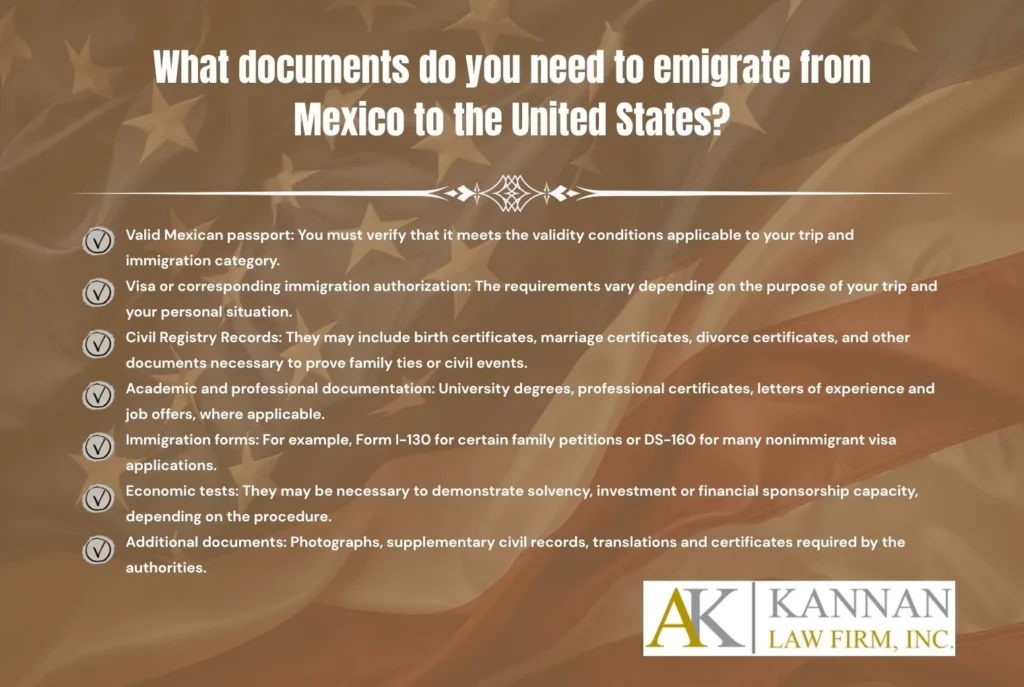
The required documents depend on the type of visa or immigration benefit you are applying for. However, it is advisable to prepare the following in advance:
- Valid Mexican passport: You must verify that it meets the validity conditions applicable to your trip and immigration category.
- Visa or corresponding immigration authorization: The requirements vary depending on the purpose of your trip and your personal situation.
- Civil Registry Records: They may include birth certificates, marriage certificates, divorce certificates, and other documents necessary to prove family ties or civil events.
- Academic and professional documentation: University degrees, professional certificates, letters of experience and job offers, where applicable.
- Immigration forms: For example, Form I-130 for certain family petitions or DS-160 for many nonimmigrant visa applications.
- Economic tests: They may be necessary to demonstrate solvency, investment or financial sponsorship capacity, depending on the procedure.
- Additional documents: Photographs, supplementary civil records, translations and certificates required by the authorities.
Religious documents, such as baptismal certificates, do not automatically replace the official civil documents required for an immigration application.
You should also keep in mind that a B-1/B-2 tourist visa does not authorize you to establish permanent residence or work in the United States. If your goal is to live or work in the country, you must identify the appropriate immigration category before traveling.
How does your profession influence your chances of emigrating?

Your occupation, work experience, and education level can determine what immigration options are available to you.
If you have a profession included in the TN visa list and a job offer that meets the requirements, this category may be an alternative worth considering.
If you have a university degree and a specialized job offer, you could consider an H-1B visa or another professional category. However, you should check for annual limits, selection processes, or other applicable requirements.
On the other hand, if you work in agriculture, hospitality, landscaping, or other sectors that offer temporary jobs, you could explore opportunities through the H-2A or H-2B programs.
Finally, if you have outstanding professional achievements, international executive experience, publications, awards, or a distinguished career path, it may be advisable to consider employment-based permanent residency categories.
Important: There is no single visa that is automatically the fastest or easiest for all Mexicans. Eligibility depends on individual circumstances and current regulations.
How does having family members in the United States affect things?
Having family members in the United States can open a path to immigration, but the relationship and the legal status of that person determine what options are available.
- If your relative is a U.S. citizen
U.S. citizens can apply for permanent residency for certain family members.
Immediate family members—spouses, unmarried children under 21, and parents (when the citizen is at least 21)—are not subject to annual visa limits. This may make their process more straightforward than for other categories, although the corresponding procedures, verifications, and approvals are still required.
Citizens can also apply for benefits for certain adult children, married children, and siblings. These categories are subject to visa limits and may involve extended wait times.
- If your family member is a permanent resident
A person who has a Green Card can file petitions for their spouse and unmarried children, including certain adult children.
However, you cannot apply for residency for your parents or siblings through the same family categories available to U.S. citizens.
In addition, petitions submitted by permanent residents are subject to numerical limits and visa availability.
How long does it take to obtain residency through a family member?
The time depends on the category, the priority date, visa availability, and the processing times of the authorities.
In some family preference categories, especially those with high demand, Mexican applicants may face waits of many years. Therefore, it is not advisable to assume that having a relative in the United States means you will be able to immigrate immediately.
Financial sponsorship (Affidavit of Support)
In many residency processes based on family sponsorship, the sponsor must submit a statement of financial support, usually using Form I-864.
This document establishes legal obligations for financial support and requires compliance with certain financial criteria. Depending on the circumstances, it may be necessary to have a qualifying joint sponsor.
Financial sponsorship does not replace other immigration requirements nor does it guarantee approval of the application.
How much money do you need to emigrate to the United States?
There is no single amount of money that everyone needs to emigrate. Expenses vary depending on the visa, government fees, professional fees, destination city, and family circumstances.
Before starting, it is advisable to prepare a budget that includes:
- Visa or residence application fees.
- Translation costs, certificates and documentation.
- Fees for immigration lawyers, if you decide to hire one.
- Transportation and travel expenses.
- Rental deposit, housing and basic services.
- Food, local transport and health insurance.
- Savings to cover the first few months while you get settled.
If you are migrating for work, verify the terms of your job offer and who will cover each expense. Do not give money to people who promise to get you a visa or a guaranteed job through unofficial channels.
Consult government sources, such as USCIS, the Department of State and the United States Embassy in Mexico, to verify the requirements and current fees.

Mistakes to avoid when emigrating from Mexico to the United States
Proper planning can help you avoid problems that affect your immigration status.
-Traveling on a tourist visa with the intention of working. The B-1/B-2 visa does not authorize ordinary employment in the United States. You must verify which category corresponds to your purpose.
-Choosing a visa without checking its requirements. A job offer does not automatically qualify you for any work visa. The occupation, the employer, and your credentials must meet specific requirements.
-Trusting in promises of guaranteed approval. No private intermediary can guarantee that the authorities will approve a visa or a Green Card. Be wary of offers that demand suspicious payments or promise immediate results.
-Ignoring the consequences of an incorrect request. False statements, fraudulent documents, or certain immigration violations can affect future applications and, in certain circumstances, have serious consequences.
-Not reviewing the options before making important decisions. Quitting a job, selling a property, or moving without knowing the requirements of your category can cause economic and immigration difficulties.
How can an immigration lawyer help you?

US immigration laws include different categories, documentary requirements, timeframes, and procedures. An immigration lawyer can help you identify options that fit your circumstances and understand the risks before you apply.
For example, an attorney can assess whether you qualify for a TN, H-1B, H-2A, or H-2B visa; analyze a potential family petition; or determine if your career path allows you to explore an employment-based permanent residence category.
It can also help you prepare documentation, review forms, identify potential eligibility issues, and respond to certain requests for evidence or notifications from authorities.
If you have a migration history, a denied application, or doubts about your entry and exit history, it is especially important to seek advice before submitting a new application or traveling.
Every case is different. Legal guidance should be based on your background, your goals, and applicable legal requirements, without promising results that depend on immigration authorities.
Call us for a free initial consultation: (619) 746-8879. At Kannan Law, we’re ready to help you. Contact us today!
Conclusion: Plan your migration process before you emigrate
Emigrating legally from Mexico to the United States requires identifying an appropriate immigration route, gathering the necessary documentation, and understanding the requirements of the chosen category.
Your profession, education, a potential job offer, and family ties can significantly influence the available options. You should also consider waiting times, costs, and obligations associated with each procedure.
Before making any important decisions, verify information from official sources and consider consulting with an immigration lawyer who can assess your particular situation.
With informed planning, you can better understand your options and make more confident decisions about your future in the United States.
Legal notice: This article is for general informational purposes only and does not constitute legal advice. Requirements, procedures, and processing times may change. Eligibility must be assessed on a case-by-case basis in accordance with current immigration law.
Frequently Asked Questions
Can I immigrate to the United States without a job offer?
Yes, it is possible under certain circumstances. For example, you may qualify through a family petition or some employment-based permanent residency categories, such as certain EB-1 or EB-2 applications with a national interest waiver. However, each category has specific requirements, and not all allow you to apply for residency without employment sponsorship.
Can I live and work in the United States with a tourist visa?
No. A B-1/B-2 tourist visa does not authorize ordinary employment or allow you to establish permanent residence. To work legally, you need employment authorization or an immigration status that permits the corresponding work activity.
Does having a relative in the United States guarantee that I can obtain a Green Card?
No. While certain U.S. citizens and permanent residents may petition for residency for eligible family members, approval depends on legal requirements, the family relationship, documentation, and, in certain categories, visa availability. Some applications may be subject to lengthy waiting periods.