
USCIS Public Charge Rule Changes Effective September 18, 2026: What Green Card Applicants Need to Know


USCIS Public Charge Rule Changes Effective September 18, 2026: What Green Card Applicants Need to Know
A significant change to U.S. immigration policy is coming on September 18, 2026.
The Department of Homeland Security (DHS) has issued a final rule rescinding the 2022 Public Charge Ground of Inadmissibility regulations. Beginning September 18, 2026, U.S. Citizenship and Immigration Services (USCIS) will have broader discretion when deciding whether certain applicants are likely to become a “public charge.”
The new rule may have important consequences for people applying for a green card through adjustment of status, as well as certain individuals seeking admission to the United States.
For immigrants and their families, understanding what is changing—and what is not—is critical.
If you have questions about adjusting your immigration status, call us today at (619) 746-8879
Key Takeaways
- A new Public Charge Rule takes effect September 18, 2026. USCIS will have broader discretion to evaluate whether certain applicants are likely to become a public charge, using a totality-of-the-circumstances approach.
- Public benefits may become part of the analysis, but receiving benefits does not automatically mean a green card will be denied. USCIS may consider certain means-tested benefits received by the applicant after September 18, while still evaluating factors such as age, health, family status, finances, education, and skills.
- Applicants should pay close attention to filing dates and documentation. Adjustment-of-status applications submitted on or after September 18 must use the new Form I-485 edition, and applicants may need stronger evidence of financial stability and self-sufficiency.
What Is the Public Charge Rule?
The “public charge” ground of inadmissibility comes from Section 212(a)(4) of the Immigration and Nationality Act (INA).
Under the law, certain individuals seeking a visa, admission to the United States, or adjustment to lawful permanent resident status may be found inadmissible if the government determines that they are likely at any time to become a public charge.
A public charge determination is not supposed to turn on one fact alone. Immigration authorities evaluate an applicant’s individual circumstances.
Federal law specifically requires consideration of factors including:
- Age;
- Health;
- Family status;
- Assets, resources, and financial status; and
- Education and skills.
When applicable, an Affidavit of Support, Form I-864, is also relevant to the public charge analysis.
What Will Change on September 18, 2026?
DHS’s new final rule rescinds the 2022 public charge regulations and gives immigration officers broader discretion to evaluate information relevant to whether an applicant is likely to become a public charge.
The final rule was published in the Federal Register on July 20, 2026 and will become effective September 18, 2026.
This is significant because the 2022 rule contained regulatory definitions and limitations concerning how USCIS conducted public charge determinations. DHS concluded that those regulations were too restrictive and prevented officers from considering all facts DHS believes are relevant under the statute.
After September 18, USCIS officers will instead conduct a broader, individualized assessment under the totality of the circumstances.
In practical terms, applicants should expect greater scrutiny of their overall financial circumstances and ability to remain self-sufficient.

Who Will Be Affected by the New Public Charge Rule?
The September 18 rule applies to:
- Applications for adjustment of status that are postmarked or electronically submitted on or after September 18, 2026; and
- Applications for admission made on or after September 18, 2026.
For many immigrants applying for permanent residence from inside the United States, this means the new framework may become part of the USCIS review of their Form I-485, Application to Register Permanent Residence or Adjust Status.
However, public charge inadmissibility does not apply to every immigration category.
Certain applicants are exempt from the public charge ground under federal law. Depending on the immigration category, exemptions may include certain refugees, asylees, humanitarian applicants, and other categories specifically protected by statute.
Because exemptions can be highly case-specific, applicants should not assume the rule applies—or does not apply—to them without examining the immigration category under which they are seeking status.
Will USCIS Consider Public Benefits?
This is one of the most important changes applicants should understand.
Under the final rule, USCIS may consider an applicant’s receipt of means-tested public benefits on or after September 18, 2026 as part of the public charge determination.
DHS has stated that USCIS intends to consider evidence showing that the applicant personally received, currently receives, applied for, or was approved or certified to receive means-tested public benefits. The final rule also makes clear that the analysis is focused on the applicant, meaning benefits received by other people are generally not relevant except in particular circumstances.
Importantly, DHS has not established an exhaustive list of every benefit that will or will not qualify as a “means-tested public benefit.” USCIS may provide examples or additional guidance as implementation approaches.
That uncertainty makes individualized legal advice particularly important.
What About Benefits Received Before September 18, 2026?
The final rule contains an important transition provision.
DHS states that benefits received before September 18, 2026 will be treated under the standards that applied under the 2022 Final Rule.
In particular, DHS says it will not retroactively consider previously excluded means-tested benefits simply because the new rule later takes effect.
This distinction matters.
Applicants should therefore be careful about relying on generalized information online that simply states that “public benefits count under the new public charge rule.” The type of benefit, date it was received, applicant’s immigration category, and individual circumstances can all matter.
Does Receiving a Public Benefit Automatically Mean Your Green Card Will Be Denied?
The short answer is no.
A public charge determination is an individualized assessment, and the receipt of a particular benefit should not automatically be equated with a denial of permanent residence.
USCIS officers must evaluate the applicant’s circumstances and make a prospective determination about whether the individual is likely at any time to become a public charge.
The new rule nevertheless gives officers broader discretion than under the rescinded 2022 regulations. Applicants with public-benefit history or financial concerns should therefore consider obtaining legal advice before filing an immigration application.
USCIS Will Issue a New Form I-485
The September 18 implementation date also brings an important procedural change.
USCIS has announced that it will publish a revised Form I-485, Application to Register Permanent Residence or Adjust Status.
The government organización specifically warns that older editions of Form I-485 postmarked or electronically submitted on or after September 18, 2026 will not be accepted, according to their website.
This creates an important filing issue for adjustment-of-status applicants and immigration practitioners.
Anyone preparing an I-485 close to the September 18 effective date should verify the edition date and filing instructions directly with USCIS immediately before submitting the application.
Using an outdated form could result in USCIS rejecting the filing.
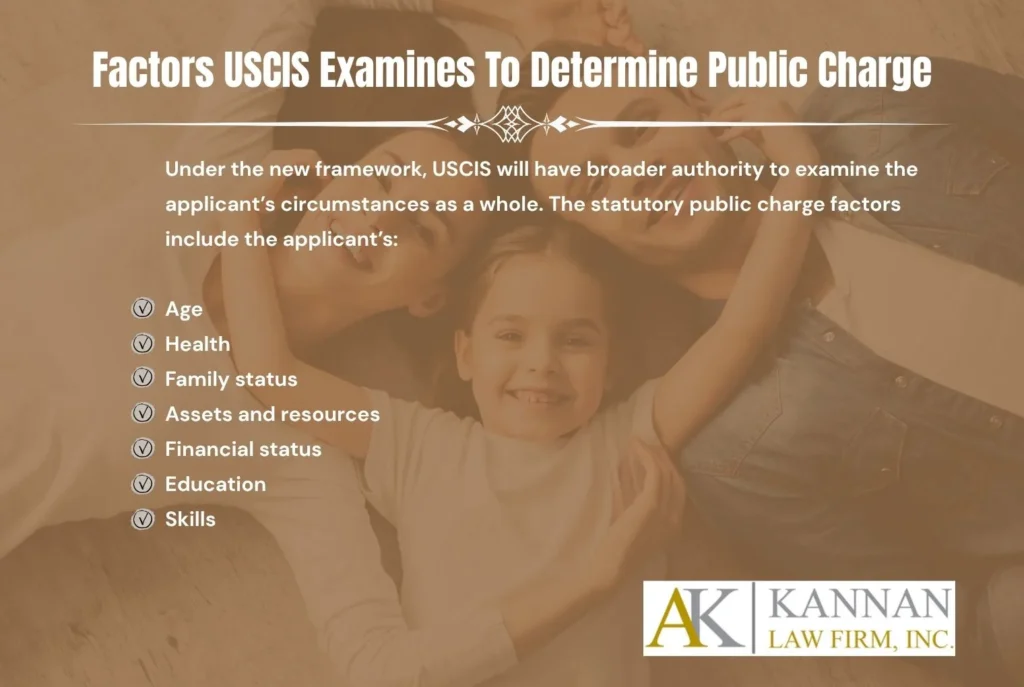
What Factors Could USCIS Examine?
Under the new framework, USCIS will have broader authority to examine the applicant’s circumstances as a whole.
The statutory public charge factors include the applicant’s:
- Age
- Health
- Family status
- Assets and resources
- Financial status
- Education
- Skills
USCIS may also consider an applicant’s receipt of means-tested public benefits and other individualized facts relevant to self-sufficiency. Where required, the applicant’s Form I-864 Affidavit of Support remains relevant.
The final rule emphasizes a case-by-case, totality-of-the-circumstances analysis, rather than a single-factor test.
Applicants May Need More Evidence of Financial Self-Sufficiency
The practical effect of the September 18 changes may be that financial documentation becomes increasingly important in adjustment-of-status cases subject to public charge inadmissibility.
Depending on the case, an immigration attorney may recommend reviewing documentation concerning:
- Household income;
- Employment history;
- Assets and savings;
- Sponsor and joint sponsor qualifications;
- Form I-864 documentation;
- Education and professional qualifications;
- Employment skills;
- Health-related circumstances;
- Prior or current receipt of public benefits; and
- Other evidence demonstrating financial stability and self-sufficiency.
The evidence appropriate for one applicant may be very different from the evidence appropriate for another.

Should You Stop Receiving Public Benefits Because of the New Rule?
Applicants should not make important healthcare, nutrition, housing, or financial decisions based solely on fear or rumors about the public charge rule.
Not every benefit necessarily triggers a public charge concern. Not every immigrant is subject to the public charge ground of inadmissibility. Benefits received by family or household members may be treated differently from benefits received by the applicant personally.
And the timing of benefits can matter significantly under the September 18 transition rules.
Before discontinuing benefits or changing an immigration strategy, consider speaking with a qualified immigration attorney who can evaluate the specific immigration category, benefit, and circumstances involved.
Filing Form I-485 Before vs. After September 18, 2026
For individuals currently preparing an adjustment-of-status application, timing may deserve particular attention.
The final rule applies to adjustment applications postmarked or electronically submitted on or after September 18, 2026.
That does not mean every applicant should rush to file before September 18. Filing an incomplete, inaccurate, or premature application can create serious problems of its own.
Instead, applicants who are eligible to file and are approaching the effective date should speak with immigration counsel about:
- Whether the new public charge framework applies to them;
- Whether they qualify for a statutory exemption;
- Whether their financial circumstances create potential public charge concerns;
- Whether additional supporting evidence should be prepared; and
- Which edition of Form I-485 must be used.
USCIS Guidance Is Still Expected
There is another reason applicants should continue watching this issue closely.
In the final rule, DHS states that USCIS will issue subregulatory guidance on or before September 18, 2026 to guide officers making public charge determinations. USCIS has also said it will train officers regarding implementation.
Because that guidance may provide additional information about how USCIS will evaluate individual cases, immigration attorneys and applicants should continue monitoring USCIS announcements as September 18 approaches.
Contact an Immigration Attorney Before Filing
The September 18, 2026 USCIS public charge changes represent an important shift in how the federal government will evaluate public charge inadmissibility.
For applicants subject to the rule, USCIS officers will have greater discretion to examine financial circumstances, statutory factors, receipt of means-tested public benefits, and other facts bearing on the applicant’s likelihood of becoming a public charge.
If you are preparing to file Form I-485 for adjustment of status, have received public benefits, are concerned about meeting the financial requirements for a green card, or are unsure whether the public charge rule applies to you, our immigration attorneys can review your circumstances and help you prepare for the new requirements.
Immigration laws and USCIS policies can change quickly. Getting advice based on your individual circumstances before filing may help you avoid preventable problems with your application.
Contact Kannan Law for more information if you are in the process of adjusting your status. We offer a free initial consultation: (619) 746-8879.
In Summary
Beginning September 18, 2026, a new USCIS Public Charge Rule will give immigration officers broader discretion to evaluate whether certain applicants are likely to become a public charge. The rule introduces a more individualized assessment that may consider an applicant’s financial circumstances, personal factors, and certain means-tested public benefits, although receiving benefits does not automatically result in a green card denial. Applicants subject to the rule should carefully review their eligibility, financial documentation, and filing strategy, particularly because USCIS will require a new edition of Form I-485 for applications submitted on or after the effective date.
Frequently Asked Questions About the 2026 Public Charge Rule
When does the new USCIS public charge rule take effect?
The final rule takes effect September 18, 2026. It applies to adjustment-of-status applications postmarked or electronically submitted on or after that date and applications for admission made on or after that date.
Does the public charge rule apply to everyone applying for a green card?
No. Certain immigration categories are exempt from the public charge ground of inadmissibility. Whether an exemption applies depends on the applicant’s particular immigration classification and circumstances.
Will Medicaid, SNAP, or other government benefits automatically cause a green card denial?
Applicants should not assume that receiving a particular benefit automatically results in denial. The new rule requires an individualized public charge determination, and DHS has not provided a single exhaustive list of all benefits that will be treated as means-tested public benefits for purposes of the new framework.
Will USCIS consider benefits my U.S. citizen children receive?
The public charge inquiry generally focuses on benefits received by the applicant. DHS has stated that receipt of benefits by someone other than the applicant is generally not relevant, subject to particular circumstances identified in its guidance and authorities.
Does the rule apply to benefits I received before September 18, 2026?
DHS has provided a prospective implementation rule. Previously excluded means-tested benefits received before September 18, 2026 will not suddenly be counted retroactively under the broader post-September 18 standard.
Is there a new Form I-485?
USCIS says it will publish a revised Form I-485. Older versions postmarked or electronically submitted on or after September 18, 2026 will not be accepted. Applicants filing around the effective date should carefully check the USCIS website for the correct form edition.
This article is provided for general informational purposes only and does not constitute legal advice. Immigration law is fact-specific, and the application of the public charge ground of inadmissibility depends on an individual’s circumstances and immigration category. Information is current as of the date of publication and may change as USCIS issues additional implementation guidance.