
Green Card for Spouse: What Is the Minimum Income Requirement for a 2026 Marriage Visa Sponsorship?


Green Card for Spouse: What Is the Minimum Income Requirement for a 2026 Marriage Visa Sponsorship?

Sponsoring a foreign spouse for a U.S. Green Card involves more than proving that a marriage is genuine. U.S. immigration law also requires the sponsoring spouse to demonstrate that they have sufficient financial resources to support their immigrant spouse and prevent them from becoming primarily dependent on government assistance.
If you are planning to apply for a Green Card for spouse in 2026, understanding the minimum income requirements, the Affidavit of Support (Form I-864), and the possibility of using a joint sponsor is essential.
So, how much does a sponsor need to make for immigration? The answer depends on household size, the sponsor’s location, and certain military exceptions. Additionally, applicants with criminal records may face immigration complications that require assistance from an experienced crimmigration attorney.
This guide explains the 2026 financial thresholds, required documentation, joint sponsor income requirements, and how an immigration lawyer can help you navigate the process.
If you have questions about immigration or adjustment of immigration status, call us today at (619) 746-8879.
Key Takeaways
- Financial eligibility is essential for marriage-based immigration. Sponsors must meet the applicable income requirements based on household size and federal poverty guidelines. If their income is insufficient, alternative options such as qualifying assets or a joint sponsor may help satisfy the financial requirements.
- Accurate documentation can prevent unnecessary delays. Tax transcripts, employment verification letters, pay stubs, bank statements, and a properly completed Form I-864 are important components of a successful financial sponsorship application.
- Criminal history can complicate Green Card eligibility. Even when a couple meets all financial requirements, certain criminal charges or convictions may create immigration barriers. Consulting a crimmigration attorney can help identify potential consequences and develop a legal strategy before proceeding.
What Is the Minimum Income Requirement to Sponsor a Spouse in 2026?
For most marriage-based Green Card applications, the sponsoring spouse must demonstrate an annual income of at least 125% of the Federal Poverty Guidelines for their household size.
This requirement applies to U.S. citizens and lawful permanent residents sponsoring eligible family members through Form I-864, Affidavit of Support.
The financial requirement is designed to demonstrate that the immigrant spouse will have adequate financial support after obtaining permanent residence.
2026 Minimum Income Requirements
The following thresholds apply to sponsors living in the 48 contiguous states, the District of Columbia, and the other jurisdictions covered by the standard poverty guideline.
The 2026 guidelines became effective for Affidavits of Support beginning March 1, 2026.
| Household size | Minimum annual income (125%) |
| 2 people | $24,650 |
| 3 people | $31,075 |
| 4 people | $37,500 |
| 5 people | $43,925 |
| 6 people | $50,350 |
| 7 people | $56,775 |
| 8 people | $63,200 |
For each additional household member beyond eight, add $6,425.
Important: These figures are different for sponsors living in Alaska and Hawaii, where higher poverty guidelines apply. Active-duty members of the U.S. Armed Forces sponsoring their spouse or qualifying child may qualify under a lower 100% threshold.
For the applicable figures, consult the USCIS Form I-864P poverty guidelines.
How Much Does a Sponsor Need to Make for Immigration?
One of the most common questions from couples beginning the marriage-based immigration process is: How much does a sponsor need to make for immigration?
There is no single income requirement for every applicant. The amount depends on the sponsor’s total household size, not simply the number of people included in the Green Card application.
For example, consider a U.S. citizen sponsoring a foreign spouse:
- If the sponsor has no children or other dependents, the household size is generally two, requiring at least $24,650 in annual income.
- If the sponsor has one dependent child, the household size generally increases to three, requiring $31,075.
- If the sponsor has two dependent children, the household size generally increases to four, requiring $37,500.
Other individuals may also need to be included, such as dependents listed on the sponsor’s most recent tax return and immigrants previously sponsored through an Affidavit of Support when the financial obligation has not ended.
Calculating household size correctly is important because an incorrect calculation can result in an incomplete application or a request for additional evidence.
Does the Sponsor Need to Earn More Than the Poverty Guidelines?
Generally, yes. Most marriage-based sponsors must demonstrate income equal to at least 125% of the applicable Federal Poverty Guidelines.
However, there are exceptions and alternative ways to demonstrate financial eligibility.
For example, qualifying active-duty military sponsors petitioning for their spouse or child may use the 100% threshold.
Additionally, sponsors who do not meet the minimum income requirement may be able to use qualifying assets or obtain assistance from a joint sponsor.
What Are the Joint Sponsor Income Requirements?

What happens if the U.S. citizen or permanent resident sponsoring their spouse does not earn enough money?
Fortunately, insufficient income does not automatically mean that a couple cannot obtain a Green Card.
A joint sponsor may help satisfy the financial requirements.
A joint sponsor is another individual who agrees to accept financial responsibility for the immigrant by submitting a separate Form I-864.
Who Can Be a Joint Sponsor?
A joint sponsor does not necessarily need to be a family member. A friend or another qualified individual may serve in this role.
However, the joint sponsor must:
- Be at least 18 years old.
- Be a U.S. citizen, U.S. national, or lawful permanent resident.
- Have a domicile in the United States.
- Demonstrate sufficient income or qualifying financial resources for their household size, including the immigrant or immigrants they are sponsoring.
Unlike a household member whose income may be combined with the petitioner’s through Form I-864A, a joint sponsor generally must independently satisfy the applicable financial requirements.

Does the Original Sponsor Still Need to Submit Form I-864?
Yes.
Even when a joint sponsor is involved, the original petitioner must still submit their own Affidavit of Support.
The joint sponsor submits a separate Form I-864 to demonstrate that the financial requirement can be met.
It is important to understand that a joint sponsor is not simply providing a letter of financial support. Signing Form I-864 creates a legally enforceable financial obligation.
What Documents Are Required to Prove Income for Marriage Visa Sponsorship?

Meeting the minimum income requirement is only part of the process. Sponsors must also provide documentation supporting the financial information reported on Form I-864.
The U.S. government evaluates the sponsor’s income, employment, tax history, and other financial resources.
The following documents are commonly required:
1. Federal Income Tax Returns
Sponsors generally need to provide their most recent federal income tax return or an IRS tax transcript.
The Department of State recommends IRS tax transcripts because they typically contain the information necessary to evaluate the Affidavit of Support more efficiently.
If the sponsor filed jointly with a spouse, additional documentation, such as W-2 forms or relevant schedules, may be necessary to establish the sponsor’s individual income.
2. Proof of Current Employment
Sponsors should provide evidence demonstrating their current employment and income.
Examples include:
- An employment verification letter.
- Recent pay stubs.
- W-2 forms.
- Documentation showing annual salary or hourly wages.
- Evidence of self-employment income, when applicable.
These documents help establish whether the sponsor’s current income meets the required financial threshold.
3. Bank Statements and Financial Assets
If the sponsor’s income is insufficient, qualifying assets may help make up the difference.
Examples include:
- Savings accounts.
- Stocks and bonds.
- Certain investment accounts.
- Real estate with documented equity.
Assets generally must be convertible into cash within one year without considerable hardship or financial loss.
For most family-based sponsorship cases, the net value of qualifying assets must equal five times the difference between the sponsor’s income and the applicable 125% poverty guideline.
For sponsors petitioning for a spouse or child of a U.S. citizen, the required asset value is generally three times that difference.
4. Form I-864, Affidavit of Support
The sponsor must complete and sign Form I-864, agreeing to financially support the immigrant.
This is a legally binding contract, and the sponsor’s financial obligations generally continue until the immigrant:
- Becomes a U.S. citizen.
- Earns 40 qualifying quarters of work under Social Security law.
- Permanently leaves the United States and loses permanent resident status.
- Obtains a new grant of adjustment of status in removal proceedings, where applicable.
- Dies.
Divorce does not terminate the sponsor’s financial obligations under Form I-864.

What Happens If the Sponsor Does Not Meet the Minimum Income Requirement?
Not meeting the income threshold does not necessarily end the marriage-based immigration process.
Depending on the circumstances, there may be several ways to address the financial shortfall.
- Using a joint sponsor: A qualified individual can submit a separate Form I-864 and demonstrate sufficient income to support the immigrant.
- Combining household income: Certain qualifying household members can contribute their income through Form I-864A, provided the applicable requirements are satisfied.
- Using qualifying assets: The sponsor may use eligible assets to compensate for insufficient income.
- Providing additional financial evidence: Current employment records, recent pay statements, and evidence of ongoing income may help establish that the sponsor’s financial situation is stronger than the tax return alone suggests.
An important distinction is that a prospective immigrant’s job offer cannot replace the sponsor’s required Form I-864 income. The government evaluates the financial sponsorship requirements separately.
How an Immigration Lawyer Can Help With Marriage Visa Sponsorship

Applying for a Green Card for a spouse involves several legal and financial requirements. Even when the couple meets the income threshold, errors in the paperwork can delay the application or lead to requests for additional evidence.
An experienced immigration lawyer can help couples navigate the process and avoid preventable mistakes.
An immigration attorney can assist with:
- Evaluating financial eligibility: An attorney can calculate the correct household size, determine the applicable income threshold, and evaluate whether the sponsor meets the financial requirements.
- Preparing Form I-864: Completing the Affidavit of Support incorrectly can create unnecessary complications. An attorney can review the financial information and supporting documentation to ensure consistency.
- Evaluating joint sponsor options: If the petitioner’s income is insufficient, an attorney can explain the joint sponsor income requirements and help determine whether another individual qualifies.
- Reviewing financial evidence: An attorney can identify missing tax documents, insufficient employment verification, or problems with asset documentation before the application is submitted.
- Addressing Requests for Evidence (RFEs): If immigration authorities request additional financial documentation, an attorney can help prepare an appropriate response.
- Navigating the Green Card process: Beyond financial sponsorship, an immigration lawyer can assist with the marriage petition, adjustment of status, consular processing, interviews, and other immigration requirements.
Professional legal guidance can be particularly important when the applicant has a complicated immigration history or additional legal issues.
Contact Kannan Law for a free initial consultation if you are looking to adjust status via marriage. Call us at (619) 746-8879.
How Can a Crimmigration Attorney Help If You Have a Criminal Case?
Marriage to a U.S. citizen or lawful permanent resident does not automatically eliminate the immigration consequences of a criminal record.
If the foreign spouse has been arrested, charged with a crime, or previously convicted of an offense, the criminal case may affect their eligibility for a Green Card.
This is where a crimmigration attorney can play an important role.
Crimmigration involves the intersection of criminal law and immigration law. It focuses on how criminal charges, convictions, and other legal proceedings can affect a person’s immigration status or eligibility for immigration benefits.
Criminal Convictions That May Affect Marriage-Based Green Card Applications
Certain criminal offenses can make an immigrant inadmissible to the United States.
Depending on the circumstances, these may include:
- Crimes involving moral turpitude (CIMTs).
- Certain controlled substance offenses.
- Multiple criminal convictions involving qualifying aggregate sentences.
- Certain drug trafficking-related conduct.
- Prostitution-related offenses.
- Certain fraud-related offenses involving immigration benefits.
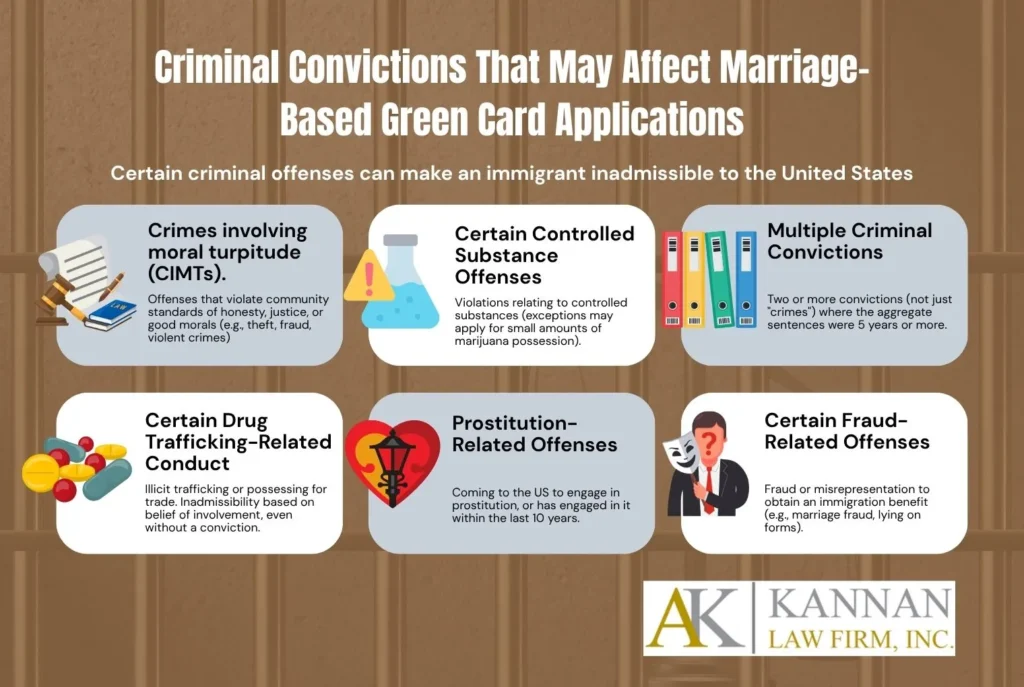
The immigration consequences depend on the specific criminal statute, the nature of the offense, the conviction record, and applicable statutory exceptions or waivers.
For example, a conviction for a crime involving moral turpitude may create an inadmissibility issue. However, certain exceptions and waivers may be available depending on the circumstances.
Drug-related offenses can also create serious immigration problems, even when the conduct was treated differently under state law.
Why You Should Consult a Crimmigration Attorney Before Accepting a Plea Deal
One of the most important considerations is that a criminal plea agreement can have consequences beyond the criminal court.
A plea deal that appears favorable because it reduces jail time or avoids a more serious criminal charge may still create immigration problems.
For noncitizens, certain convictions can result in:
- Denial of a Green Card application.
- Inadmissibility at a U.S. consulate or port of entry.
- Deportation or removal proceedings.
- Difficulty adjusting immigration status.
- Loss of eligibility for certain immigration benefits.
A crimmigration attorney can evaluate the criminal charge from both a criminal defense and immigration perspective.
Depending on the case, legal counsel may be able to:
- Review the criminal statute and potential immigration consequences before a plea is entered.
- Identify alternative plea options that may reduce immigration consequences.
- Evaluate whether an available criminal post-conviction remedy could help address an existing conviction.
- Determine whether the applicant may qualify for an immigration waiver.
- Coordinate criminal defense and immigration strategies to protect the client’s ability to pursue permanent residence.
An important distinction: The criminal history of the immigrant spouse and that of the sponsoring spouse do not necessarily have the same immigration consequences. A sponsor’s criminal record does not automatically change the financial sponsorship threshold, but certain circumstances may raise separate legal concerns that should be evaluated individually.
When criminal and immigration matters overlap, working with an attorney who understands both areas of law can be critical.
At Kannan Law, we can help with both the immigration and criminal defense cases you may be going through. Contact us today!
Conclusion: Get the Financial and Legal Requirements Right Before Applying
Understanding the minimum income requirement for a 2026 marriage visa sponsorship is an essential step toward obtaining a Green Card for your spouse.
For most sponsors living in the contiguous United States, the minimum annual income begins at $24,650 for a household of two and increases according to household size.
If the sponsoring spouse does not meet the financial requirements, a joint sponsor, qualifying household income, or eligible assets may provide an alternative.
However, financial eligibility is only one part of the immigration process. Criminal charges, previous convictions, inadmissibility issues, and other legal complications can create additional obstacles.
An experienced immigration lawyer can help ensure that the financial sponsorship requirements are properly addressed, while a crimmigration attorney can evaluate criminal cases that may affect the immigrant’s ability to obtain permanent residence.
Getting the right legal guidance early can help couples avoid costly mistakes and move forward with greater confidence in their marriage-based immigration application.
Frequently Asked Questions
Does getting married to a U.S. citizen automatically qualify someone for a Green Card?
No. Marriage to a U.S. citizen creates a potential pathway to permanent residence, but it does not guarantee approval. Applicants must establish that their marriage is legally valid and genuine, meet applicable admissibility requirements, and complete the required immigration procedures. Immigration authorities may also request evidence demonstrating that the relationship was entered into in good faith.
Can a marriage-based Green Card application be denied even if the sponsor meets the income requirements?
Yes. Meeting the financial sponsorship requirements does not guarantee approval. Applications may be denied because of insufficient evidence of a genuine marriage, misrepresentation, certain immigration violations, inadmissibility grounds, or other eligibility issues. Each application is evaluated based on the applicant’s individual circumstances.
What happens if the sponsoring spouse loses their job while the Green Card application is pending?
A significant change in employment or income may affect the financial sponsorship assessment. The sponsor may need to provide updated financial documentation, and a joint sponsor may become necessary if the original sponsor can no longer demonstrate sufficient income. An immigration attorney can evaluate the situation and recommend the appropriate steps to avoid complications.