
Can a TN Visa Holder Get a Green Card Through Marriage to a Permanent Resident?


Can a TN Visa Holder Get a Green Card Through Marriage to a Permanent Resident?

A Canadian or Mexican citizen working in the United States as a TN visa holder may be eligible for permanent residence through marriage to a lawful permanent resident, commonly called a Green Card holder.
A TN status is a special non-immigrant work authorization that allows qualified citizens of Canada and Mexico to work temporarily in pre-approved professional occupations in the United States.
However, adjustment of status for a TN professional married to a permanent resident can be significantly more complicated than adjustment through a U.S. citizen spouse.
The difference is critical.
If you have questions about adjusting your immigration status, call us today at (619) 746-8879
Key Takeaways
- A TN holder can potentially obtain a Green Card through marriage to a lawful permanent resident, but the process is more complicated than marriage to a U.S. citizen because the spouse generally falls under the F2A family-preference category, which is subject to visa availability.
- Filing Form I-130 does not give a TN holder lawful immigration status or work authorization. The applicant generally must continue maintaining valid TN status while waiting for an immigrant visa to become available, and unauthorized employment or a lapse in status can create adjustment-of-status problems.
- TN status and permanent-residence plans can create a potential conflict involving immigrant intent. Because TN classification requires temporary intent, future TN extensions, visa applications, readmissions, and international travel should be carefully planned alongside the Green Card process.
Why TN Holders Married to Green Card Holders Face Unique Immigration Challenges
A spouse of a U.S. citizen is an “immediate relative” under U.S. immigration law. A spouse of a lawful permanent resident generally falls within the F2A family-sponsored preference category.
That distinction affects visa availability, maintenance of immigration status, unauthorized employment, and the timing of the adjustment application.
At the same time, TN itself is a temporary nonimmigrant classification that does not provide the same protection for immigrant intent as H-1B or L-1 status.
For these reasons, a TN holder married to a Green Card holder should carefully evaluate the immigration strategy before filing an I-130, traveling internationally, seeking a new TN admission, or allowing TN status to expire.
Can a Green Card Holder Sponsor a TN Spouse?
Yes.
A lawful permanent resident may file Form I-130, Petition for Alien Relative, for a husband or wife.
The beneficiary generally falls within the F2A category for spouses and qualifying children of lawful permanent residents.
But filing an I-130 does not necessarily mean the TN spouse can immediately file Form I-485.
That depends in part on immigrant visa availability.

Why Visa Availability Matters for an LPR Spouse
There is no numerical visa limitation for the spouse of a U.S. citizen.
The situation is different for the spouse of a permanent resident.
F2A is a numerically limited family-preference category. Whether the TN spouse can file Form I-485 depends on the priority date and the applicable Department of State Visa Bulletin chart USCIS designates for adjustment filings.
This creates an important strategic issue.
A TN holder may have an approved or pending I-130 but still be unable to file an I-485 if an immigrant visa is not available for adjustment purposes.
During that period, the applicant must pay particular attention to maintaining lawful TN status.
The Critical Difference: Maintaining Lawful Status

This is one of the biggest potential traps in a TN-to-Green-Card case involving an LPR spouse.
The spouse of a U.S. citizen is exempt from certain adjustment bars relating to overstays, unauthorized employment, and failure to continuously maintain lawful status.
The spouse of a lawful permanent resident generally does not receive that same immediate-relative exemption.
Under INA § 245(c)(2), certain applicants who fail to maintain lawful immigration status, are in unlawful status when they file for adjustment, or engage in unauthorized employment can be barred from adjustment under INA § 245(a).
Therefore, a TN holder married to an LPR should not assume:
“My spouse filed an I-130 for me, so I can simply remain in the United States until my Green Card becomes available.”
That can be a serious mistake.
An I-130 petition does not, by itself, grant lawful immigration status.
Example: Why This Can Become a Problem
Consider a TN professional whose status expires while an I-130 filed by an LPR spouse is pending.
The applicant remains in the United States after TN status expires, expecting to file Form I-485 when the priority date becomes current.
By the time a visa becomes available, the applicant may have failed to continuously maintain lawful status.
Unlike an immediate relative of a U.S. citizen, the spouse of an LPR may be subject to the INA § 245(c) adjustment bars.
What looked like a straightforward marriage-based Green Card case may therefore become substantially more complicated.
TN Status Creates a Second Problem: Immigrant Intent
Maintaining TN status while waiting for an immigrant visa can itself require careful planning.
TN is a temporary classification.
Under the USMCA rules governing TN professionals, temporary entry means entry without the intent to establish permanent residence.
This means TN does not provide the same broad “dual intent” protection associated with classifications such as H-1B and L-1.
An approved or pending I-130 does not necessarily prove that every subsequent TN application must be denied. The Department of State recognizes that an intention to immigrate in the future does not necessarily defeat TN eligibility when that future intention is not connected to the immediate proposed TN entry.
But once the TN professional has developed a present intention to remain permanently in the United States, obtaining another TN visa or seeking readmission in TN status can become much more difficult.
The TN/LPR Marriage Dilemma
This creates a potential immigration Catch-22 (a paradoxical situation where an immigrant or policy goal is trapped by contradictory rules, making a desired outcome impossible to achieve).
The applicant may need to maintain TN status because he or she cannot afford to fall out of lawful status while waiting to become eligible for adjustment.
At the same time, increasingly concrete steps toward permanent immigration can complicate future TN visa applications or admissions because TN requires temporary intent.
That is why these cases should be planned prospectively rather than after the TN expiration date is approaching.
Filing an I-130 Does Not Give the TN Holder Immigration Status
This point deserves emphasis.
An I-130 is an immigrant petition establishing a qualifying family relationship.
It does not ordinarily:
- Extend TN status;
- Provide employment authorization;
- Protect the beneficiary from accruing unlawful presence;
- Automatically authorize the filing of Form I-485; or
- Give the beneficiary permission to remain in the United States indefinitely.
A TN holder with an I-130 filed by an LPR spouse must separately determine how he or she will maintain lawful immigration status while waiting for adjustment eligibility.
Can the I-130 and I-485 Be Filed Together?
Potentially, but only if an immigrant visa is available and all other adjustment requirements are satisfied.
F2A visa availability can change.
Applicants therefore need to consult both the Department of State Visa Bulletin and USCIS’s monthly determination concerning which chart may be used for adjustment-of-status filings.
A category that permits filing during one period can later retrogress.
That makes timing particularly important in TN cases.
What Happens After the I-485 Is Properly Filed?
Once an eligible applicant properly files Form I-485, the immigration analysis changes significantly, but a pending I-485 should not be confused with TN status itself.
The applicant may apply for employment authorization based on the pending adjustment application and may also seek advance parole for qualifying international travel.
Until appropriate independent employment authorization exists, the applicant should carefully observe the limitations of existing TN employment authorization.
Traveling Outside the United States Can Be Dangerous
International travel is particularly important for TN holders pursuing permanent residence.
Once Form I-485 has been filed, departing the United States without appropriate advance parole can result in abandonment of the adjustment application unless a specific exception applies.
TN holders should not assume they receive the same travel protections available to certain H or L nonimmigrants with pending adjustment applications.
There is also a separate immigrant-intent problem.
A TN holder who has clearly demonstrated a present intention to permanently immigrate may have difficulty establishing eligibility for another TN admission at a port of entry or another TN visa at a U.S. consulate.
International travel should therefore be discussed with immigration counsel before departure.
What If the Permanent Resident Spouse Becomes a U.S. Citizen?
This can dramatically change the case.
If the petitioning spouse naturalizes while the immigration process is pending, the beneficiary may generally move from the F2A preference category to the immediate-relative category as the spouse of a U.S. citizen.
This can have major consequences.
Immediate relatives are not subject to the same numerical visa limitations and are exempt from certain adjustment bars that apply to family-preference applicants.
Depending on the procedural posture of the case, naturalization of the petitioning spouse can therefore substantially improve the beneficiary’s adjustment options.
The case should be reviewed immediately after the petitioner naturalizes rather than simply waiting for USCIS to discover the change.
What About Unauthorized Employment?
This is another significant distinction between marriage to a U.S. citizen and marriage to an LPR.
Unauthorized employment can create an adjustment bar for applicants who do not fall within an applicable exemption.
A TN worker should therefore be particularly careful about:
- Working after TN employment authorization expires;
- Working for an employer not authorized under the TN classification;
- Beginning work for a new employer without proper authorization; or
- Assuming that a pending I-130 permits employment.
These issues should be identified before an I-485 is filed.
Should a TN Holder Married to an LPR Use Consular Processing Instead?

Sometimes consular processing may be worth considering, particularly where maintaining TN eligibility and adjustment eligibility simultaneously presents difficulties.
But consular processing creates its own issues.
Departing the United States can have serious consequences for someone who has accumulated unlawful presence or has other grounds of inadmissibility.
Additionally, the applicant must ultimately qualify for the immigrant visa.
The decision between adjustment of status and consular processing therefore should not be made without reviewing the applicant’s entire immigration history.
Important Questions to Review Before Filing
A TN professional married to a Green Card holder should determine:
- When does the current TN status expire?
- When was the applicant’s most recent admission?
- Has the applicant continuously maintained lawful status?
- Has the applicant ever worked without authorization?
- Has the LPR spouse already filed Form I-130?
- What is the applicant’s priority date?
- Is an immigrant visa currently available for filing the I-485?
- Does the applicant anticipate international travel?
- Will another TN extension, visa, or admission be necessary?
- Has the petitioner applied or become eligible for U.S. citizenship?
- Does the applicant have any previous immigration violations or grounds of inadmissibility?
These questions can determine whether adjustment of status is available at all.
TN to Green Card Through an LPR Spouse Requires Careful Planning
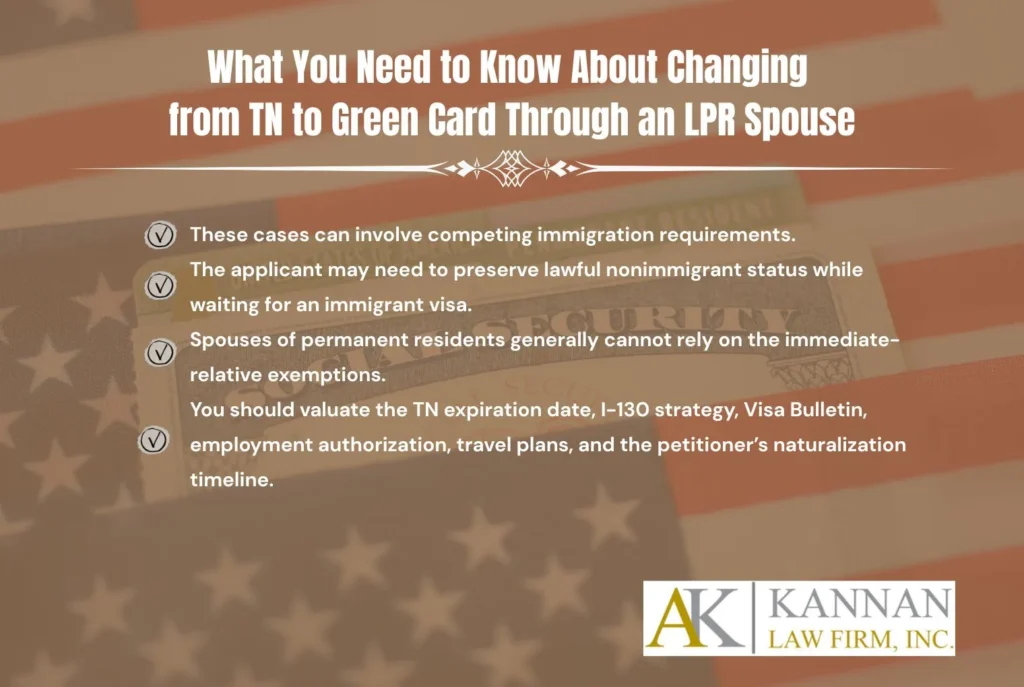
A TN professional married to a lawful permanent resident may have a path to a Green Card, but these cases can involve competing immigration requirements.
The applicant may need to preserve lawful nonimmigrant status while waiting for an immigrant visa, yet TN classification itself requires temporary intent.
Additionally, unlike many spouses of U.S. citizens, spouses of permanent residents generally cannot rely on the immediate-relative exemptions to cure certain status violations or unauthorized employment.
The safest strategy is therefore usually to evaluate the TN expiration date, I-130 strategy, Visa Bulletin, employment authorization, travel plans, and the petitioner’s naturalization timeline together rather than treating them as separate immigration issues.
Speak With an Immigration Attorney Before Changing Your TN Strategy
If you are in TN status and your spouse is a lawful permanent resident, obtaining immigration advice early can help prevent a potentially correctable situation from becoming an adjustment-of-status problem.
A careful immigration analysis can determine whether adjustment is currently available, whether TN status should be maintained, whether consular processing should be considered, and whether the petitioning spouse’s future naturalization may provide a better path to permanent residence.
Contact Kannan Law today for a free initial consultation. Call us at (619) 746-8879 or fill out the form!
Frequently Asked Questions
Can a Green Card holder sponsor a spouse who is in TN status?
Yes. A lawful permanent resident can file Form I-130 for a spouse, who generally falls within the F2A family-sponsored preference category. However, approval of the I-130 does not automatically make the spouse eligible to file Form I-485.
Does filing an I-130 allow a TN holder to remain in the United States?
No. An I-130 establishes the qualifying family relationship but does not extend TN status, provide employment authorization, or give the beneficiary permission to remain indefinitely in the United States. The TN holder must separately determine how to maintain lawful status while waiting for adjustment eligibility.
Can a TN holder and permanent resident spouse file the I-130 and I-485 at the same time?
Potentially. Concurrent filing may be possible when an immigrant visa is available and the applicant meets the other adjustment requirements. Because F2A visa availability can change or retrogress, applicants should monitor the applicable Visa Bulletin and USCIS filing-chart determination.
Can traveling outside the United States affect a TN holder’s Green Card case?
Yes. International travel can create significant issues. After filing Form I-485, leaving the United States without appropriate advance parole can result in abandonment of the adjustment application unless an exception applies. Travel can also raise TN immigrant-intent concerns if the applicant has demonstrated a present intention to immigrate permanently.
What happens if the permanent resident spouse becomes a U.S. citizen?
The case can potentially become substantially easier. When the petitioning spouse naturalizes, the beneficiary may generally move from the F2A preference category to the immediate-relative category. This removes the numerical visa limitation and can provide exemptions from certain adjustment bars that apply to family-preference applicants.